
Projecting that global oil prices would stabilise at around $30-35 and help ease pressures on consumers, Reliance Industries Chairman Mukesh Ambani on Wednesday sought deregulation of natural gas, terming it as an alternate fuel in the medium term.

A fire in Indore, India, killed eight members of a family after an explosion at an electric vehicle (EV) charging point outside their house. The Madhya Pradesh government has ordered an investigation and plans to create a Standard Operating Procedure (SOP) for EV charging.

'In such a scenario, Iran could proclaim itself victor, rebuild, re-enforce its diminished regional proxies to further destabilise neighbouring nations and take control of the Persian Gulf and Strait of Hormuz.'

'What we have yet to see on either the US or the Iranian side is willingness to compromise on their ultimate demands and the flexibility to reach an agreement to end the war.

There are hopes of a turnaround in overall corporate earnings after six quarters of single digit growth.

Bank shares were the top gainer in early trades with Bank of Baroda up over 4%.
The Indian industry wants the government adopt a multi-pronged approach to de-risk the country's oil needs by conserving energy, promoting alternative sources and building strategic reserves, a Federation of Indian Chamber of Commerce and Industry su
The rupee appreciated 13 paise to close at 90.34 against the US dollar on Thursday, on trade deal optimism and overnight decline in commodity prices, even as the upside remained capped as investors look for more clarity on the India-US trade deal.

Modi made a strong case for a partnership between the producers and consumers in the oil market as it exists in other markets.

India has denied making any payments to Iran to secure safe passage for its vessels through the Strait of Hormuz, following reports that Indian vessels were fired upon in the region.
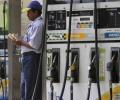
Sri Lankan President Anura Kumara Dissanayake has announced an economic relief package to mitigate the impact of the West Asia conflict, including fuel price reductions and support from India for petrol and diesel supplies.

In his first major national address since hostilities began, Trump said the ongoing military campaign, dubbed 'Operation Epic Fury', has delivered 'swift, decisive, overwhelming victories'.

The rupee breached 90-levels against the greenback for the first time on Wednesday, falling 6 paise to 90.02 in early trade, as banks kept buying US dollars at higher levels and FII outflows continued.

Suzuki Motorcycle India Ltd (SMIPL) has revised its domestic two-wheeler sales growth estimate for FY27 downwards from 7-8 per cent, citing rising commodity costs due to the ongoing West Asia conflict and its impact on consumer affordability.
The government will continue the policy of equitable burden sharing between the state, oil companies and consumers for absorbing the impact of the upward spiral in global oil prices.

Markets will look for clear guidance on how the MPC interprets the uncertainty and what it implies for the future course of monetary policy, points out Rajeswari Sengupta.

"We have the toughest sanctions ever imposed. But on oil, we want to go a little bit slow because I don't want to drive the oil prices in the world up," Trump told reporters.
India's large foreign exchange reserves can cushion a short-term jump in oil prices, but a long drawn conflict in Iraq could hurt the economy

Saudi Arabia and the UAE are actively pushing Trump to take the war to its bitter finish and 'erase' Iran's presence in the geopolitics of the region. Simply put, the two most powerful Sunni Arab oligarchies are on the same page as Israel. Such interference increases the risk of a breakdown in dialogue between the US and Iran, points out Ambassador M K Bhadrakumar.

In a significant diplomatic manoeuvre aimed at de-escalating regional tensions, Iran has reportedly submitted a "new proposal" to the United States through Pakistani intermediaries.
Rising geopolitical uncertainty, a falling dollar and the growing speculative interest in commodities trading will keep crude prices volatile.

Fathali further stated that Tehran has instructed its embassy in India to facilitate the Indian government, ensuring smooth operations amid the ongoing regional conflict.

CAD, which is the difference between outflow and inflow of foreign currency, touched a historic high of 6.7 per cent in the third quarter.

The BSE Sensex and the Nifty 50 declined around 4.5 per cent each since the start of the West Asia conflict.
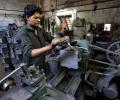
India's manufacturing sector growth slowed to a four-year low in March, impacted by cost pressures, competition, market uncertainty, and the Middle East conflict, according to the HSBC India Manufacturing PMI.
There has been a dramatic decline in oil prices from the high of $147 a barrel in July, to less than a third of that today. However, it is too early to say if this is a fundamental change in the direction of oil prices, resulting from the announced cuts in production by the oil-exporting countries, or a blip in a falling market. The government seems to be assuming (or hoping that it is) the latter and is rushing ahead with its price cut plan.

AIADMK general secretary Edappadi K Palaniswami has announced a series of welfare measures, including free refrigerators for rice ration cardholders, if the party wins the 2026 Assembly election in Tamil Nadu.

The government should start with two assumptions: first, that oil prices are fundamentally unstable and susceptible to wide fluctuations, and second, that raising the prices of petroleum products is politically difficult.
Indian banks are urging the Reserve Bank of India (RBI) to reconsider its new $100 million cap on net open foreign-exchange positions, warning that the directive could lead to significant mark-to-market (MTM) losses and force an accelerated unwinding of trades, potentially impacting FY26 earnings.

India has condemned the escalating attacks on commercial shipping in West Asia, particularly after a Thai-flagged vessel en route to India's Kandla Port was targeted in the Strait of Hormuz. The attacks have disrupted global oil and gas supplies, impacting India's energy imports.
Responding to concerns raised by Leader of the Opposition Rahul Gandhi in the Lok Sabha, Petroleum Minister Hardeep Puri said it is the foremost priority of the government that the kitchens of over 33 crore families, especially the poor and the underprivileged, do not face any shortage of gas.

Shares of Oil marketing companies (OMCs) extended their gains for the fourth consecutive session on Thursday after crude oil prices plunged to six-month lows in the international markets, which boosted investor sentiments. Traders said the OMC stocks gained with crude oil prices hovering below $70 per barrel after OPEC-plus decision to increase output from April, a move which is expected to favour Indian refiners with added marketing margins on retail fuel.

With an eye on the adverse fallout of rising oil prices, the Reserve Bank of India (RBI) on Monday said the government's subsidy bill for petroleum products and fertilisers might cross the projections for 2011-12 and put fiscal consolidation plans under strain.

Indian benchmark indices Sensex and Nifty surged over 1 per cent, with the Sensex jumping 918.60 points, driven by strong buying in banking and financial counters and a positive trend in global equities, fuelled by hopes of easing West Asia tensions.

Amid rising tensions, Iran reportedly launched ballistic missiles toward a US-UK military base, prompting concerns about regional stability and the potential for escalating conflict in the Middle East.
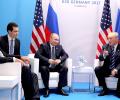
The trade relationship between India and the United States has been strained by the imposition of 25% tariff by the US on Indian goods.

External Affairs Minister S Jaishankar addresses the Indian Ocean Conference, expressing deep concern over the West Asia conflict and its economic repercussions on energy, trade, and food security. India calls for a swift return to peace and opposes targeting civilians and infrastructure.
